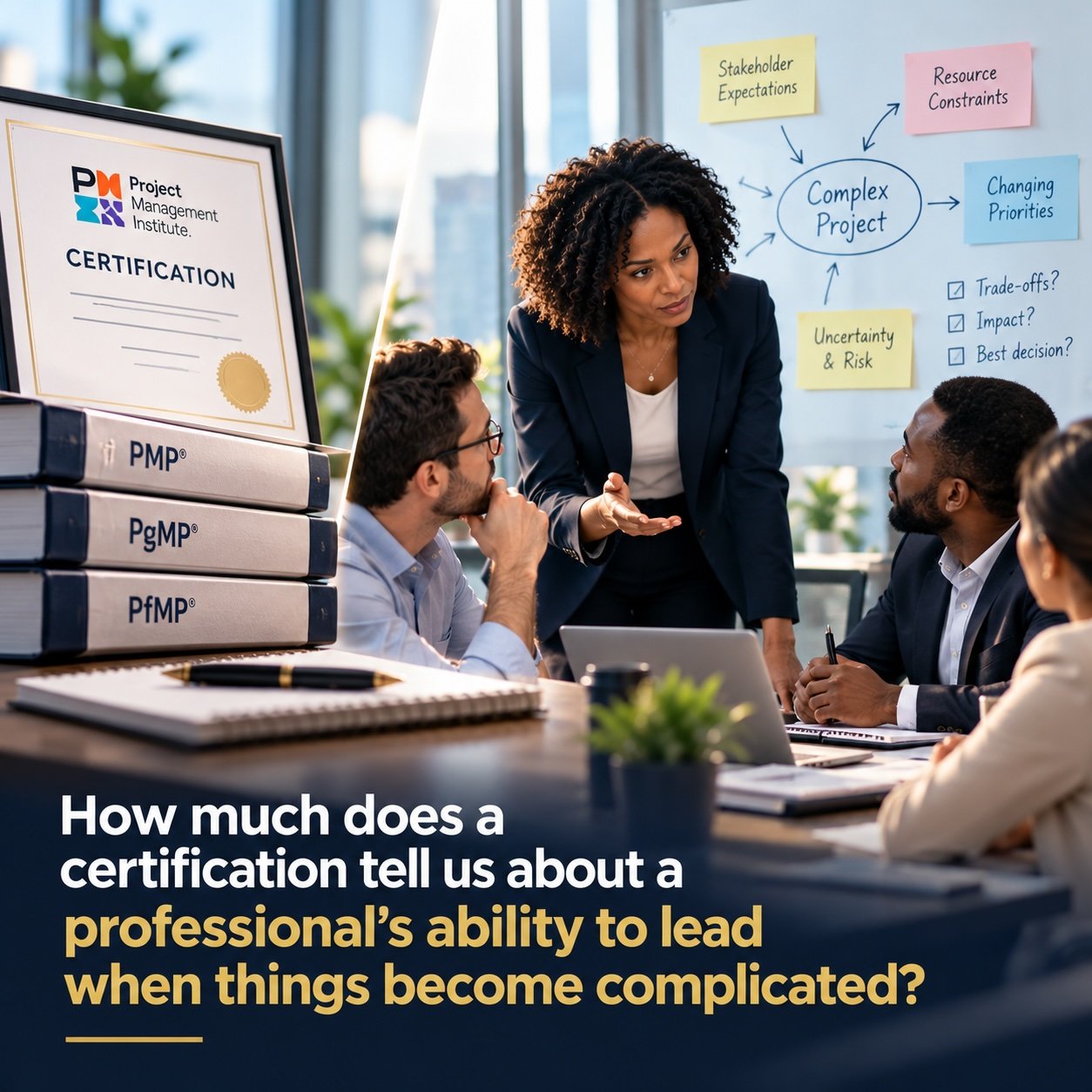
A certification exam can tell us a lot about what a project professional knows. But how much does it tell us about their ability to lead when things become complicated, priorities conflict and decisions have to be made with incomplete information? This is what caught my attention about the Advanced Project Leader (APL) certification introduced by the Project Management Institute at its Global Summit this week.
Unlike a certification based solely on passing an examination, the APL pathway also requires candidates to demonstrate advanced leadership performance through an evaluation programme at a PMI-accredited organisation. Candidates must already hold an active PMP, PgMP or PfMP certification, and the assessment covers areas such as leadership, strategic thinking, stakeholder engagement, problem-solving and managing uncertainty. What I find interesting is the emphasis on demonstrated competence alongside technical knowledge.
Knowing how to manage risks, develop schedules or apply governance frameworks is important. But leading a complex project or programme often involves situations where the right course of action is not immediately obvious.
You may have a sponsor pushing to maintain a launch date, an operational team raising concerns about readiness and stakeholders whose priorities are pulling in different directions. The project leader must understand the implications, negotiate difficult trade-offs and help the organisation reach a decision without losing sight of the intended outcome.
These are capabilities that become clearer through actual performance, not simply through the ability to explain a methodology.
I also think this raises an important question for organisations. How effectively are we developing and evaluating these capabilities internally? Are experienced project professionals being assessed only on delivery metrics and technical knowledge, or are we also looking at their judgement, influence, adaptability and ability to manage complexity?
Of course, another certification does not automatically produce better leaders. The value of this approach will depend on how consistently and fairly practical competence is assessed. It is also worth noting that the APL pathway is currently limited to eligible professionals evaluated through PMI-accredited organisations. Nevertheless, I think the development is worth following because it puts attention on something important in our profession: the difference between knowing how project management should work and being able to lead effectively when the reality becomes difficult.
For me, the most meaningful evidence of advanced project leadership is not simply what someone knows, but how they apply that knowledge when the decisions, people and outcomes really matter.
Good ideas get better in conversation.