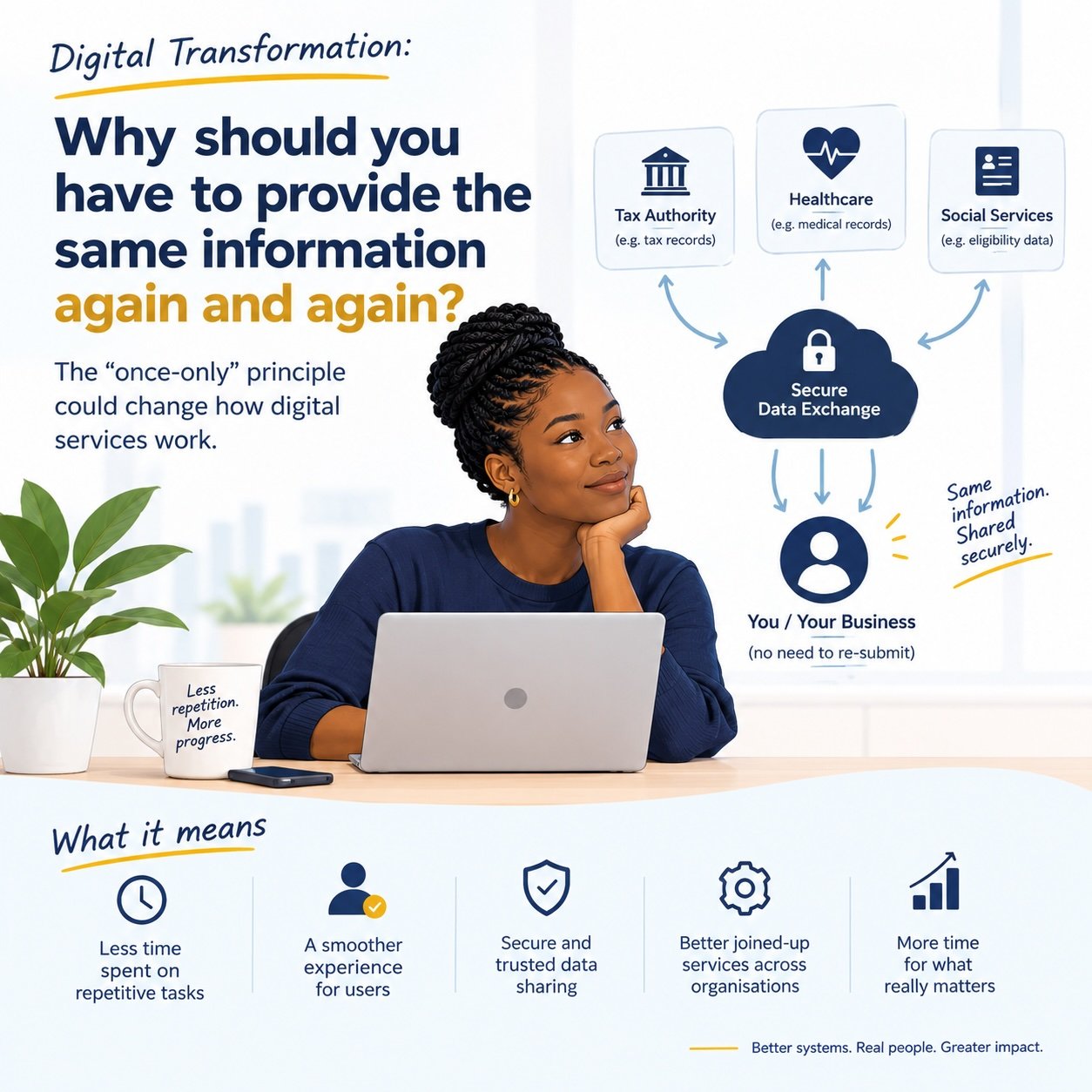
One of the most interesting ideas in digital transformation is also one of the simplest: if an organisation already has your information, why should you have to provide it again?
Think about the last time you completed an online application and had to upload a document you had already submitted somewhere else. The form may be digital, but the underlying process still depends on you carrying information between systems that don't communicate.
The European Union is working on an approach called the “once-only” principle. Its Once-Only Technical System is designed to let public authorities securely request and exchange certain official documents at a citizen's or business's request, instead of repeatedly asking people to submit the same evidence. The shared infrastructure has been operational since 2023, although bringing national authorities and services on board remains a continuing effort.
For me, the idea is interesting because it changes how we think about a successful digital transformation programme. One department can launch an attractive portal and report that its services are now online. Another can automate its approvals. Yet a person using both services may still be downloading files from one system and uploading them into the next.
That's not necessarily a problem that another app or dashboard will solve. It requires organisations to agree on how information can be shared, which source is authoritative, who can access it, what consent or legal basis is required, and what happens when the data is wrong or unavailable. Those decisions cut across technology, operations, security and governance.
This also changes what programme teams should measure. Beyond the number of systems launched or processes digitised, what steps have users stopped repeating? How much time has been saved? Can information move securely between services without making people act as the messenger?
The wider lesson applies well beyond government. Banks, insurers, healthcare providers and large enterprises all operate services where a customer's journey crosses departmental boundaries.
Sometimes the most valuable outcome of digital transformation isn't making an existing task faster. It's removing the need for people to do that task in the first place.
Good ideas get better in conversation.